
Frequently Asked Questions on Expertise
What is expertise? What makes experts so special? How do you train expertise? And other frequently asked questions

Professionally, I research and train expertise. Somewhat less professionally I write about it on Substack.
I typically work in domains like medicine, military tactics, law enforcement, and petrochemical safety, but I also explore implications for sports, music, video games, and recently mathematics. Because of this, I receive a lot of questions about the nature of expertise which I thought could be cleared up with a FAQ.
It is important to note my background. I come from a tradition called Naturalistic Decision Making (NDM) which puts more emphasis on decision-making, cognition and the ability to adapt to novel circumstances, and less focus on memorization, repetition, and motor skills. It also means that I approach cognition in a certain way that other schools of thought may disagree with. I will do my best to explain my answers, but other researchers may disagree with me, and that is OK. The science is not completely settled.1
With that caveats out of the way, here are some frequently asked questions.
What is expertise?
Expertise can be defined in terms of (1) absolute performance on a task, (2) performance relative to others, or (3) the underlying psychology. Which definition you use depends on what you are trying to accomplish. Because I am interested in the psychology of expertise, I tend to focus on that third definition, and think of expertise as the natural development of human capacity.
One way to think of the psychology of expertise is that is an ability to see and act on a problem and its solution quickly and effectively by relying on experience. Or to be more pithy; it is an uncommon common sense.
Consider what it is like to make a left hand turn at a busy intersection (or a right hand turn if you live in a country that drives on the wrong side of the road). You must decide
when to start slowing down
how fast to slow down (which requires deciding how much to press the peddle)
whether to come to a complete stop
how far to pull into the middle of the intersection
the moment to turn
which lane to turn into
whether to use your turn signal (yes)
etc.
Then, ON TOP of all that, you have to pay attention to
where you are in your lane
the cars next to you
the oncoming traffic, and whether they are slowing down or speeding up
pedestrians that might be crossing the street
cars behind you that might rear end you
the color of the light signal
etc.
That is incredibly complex! Yet, for someone with years of experience, making a left-hand turn doesn’t feel like a series of decisions requiring deliberation; it feels like common sense. Like you are just doing the obvious thing that you are supposed to do in that situation.
Well, that’s expertise. Experts often report that they don’t make decisions and are just following procedure. They have seen the same situational patterns so many times that they are able to quickly understand and know what to do, just like common sense.
How do experts do it? What makes them special?
Expertise is not about knowing lots of explicit facts, but instead defined by what we call tacit knowledge; that is knowledge that is hard to articulate because it is so implicit to how we move about in the world.
Tacit knowledge is all the things that sometimes get called intuition; our ability to make subtle distinctions, understand causal relations, notice anomalies, and recognize patterns. Because tacit knowledge is hard to articulate, we sometimes use the phrase deep expertise to differentiate experts with tacit knowledge from people who merely know a lot of stuff (e.g., academic expertise).
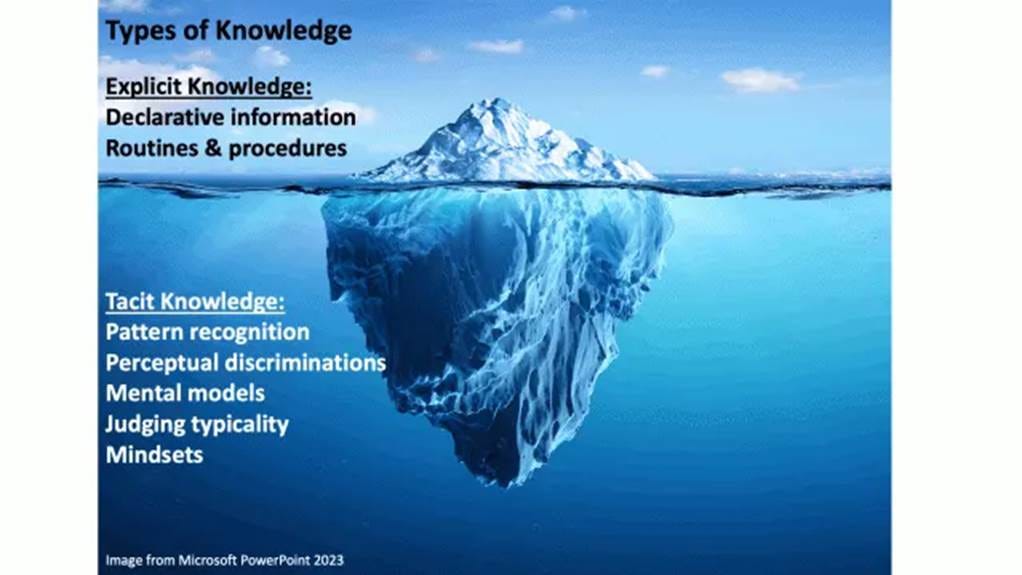
Why is this focus on tacit knowledge so important for understanding expertise? Because if the relevant knowledge were easily articulated, then you could just turn it into a series of protocols and procedures which you could follow. In other words, if performance depends on explicit knowledge, then no expertise is required as you could just follow a checklist. It is precisely the fact that some types of knowledge are hard (or impossible) to articulate which makes expertise necessary and possible.
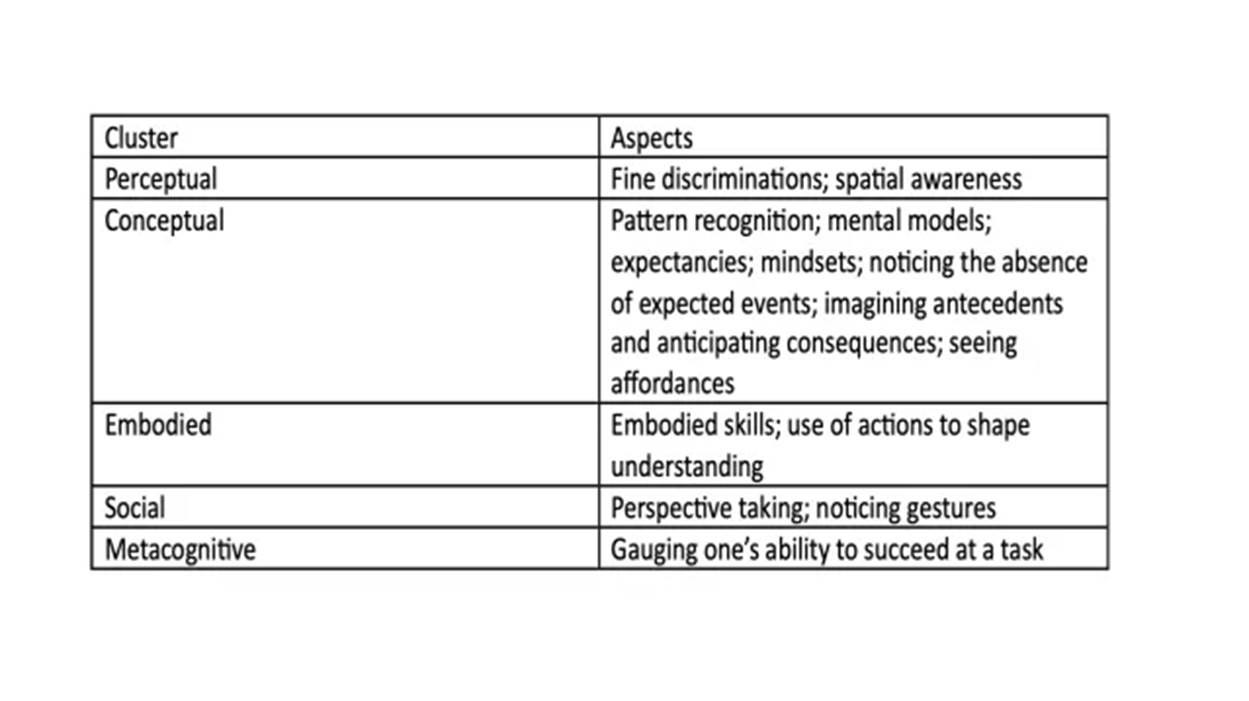
For example, how would you describe to someone with no experience how fast to slow down at a red light? Or how to anticipate whether you will get T-boned if you turn now rather than waiting for the next car? Or consider how you must anticipate cars changing lanes even though not everyone uses their blinker. Are these things even articulable? Or do you just get a feel for it? That feel is what we call tacit knowledge because of how difficult (or impossible) it is to articulate.
What is meant by pattern recognition?
Patterns can be anything which triggers recognition. A Chess Grand Master might recognize a move their opponent is trying to make; a driver might recognize the signs that someone else on the road is driving angry; a football player might recognize the play the opponents are about to try.
The patterns we notice are often hard to articulate which makes them a type of tacit knowledge, and often the most important type of tacit knowledge. Pattern recognition is central to the Recognition Primed Decision-Making model which details how experts act in the real world, describing how recognition helps us know what to expect, what other cues to look for, what goals to pursue, and what actions to take. It is also central to the Data-Frame Theory of Sensemaking, another important theory describing how experts operate in real world environments when the full story is missing.
However, it is important to note that one of the defining characteristics of experts is their ability to adapt, and this often requires recognizing novel patterns they have never seen before, and figuring out which patterns (of the billions of potential patterns) are actually relevant. There is a circularity here that is hard to explain (how could you recognize something you have never seen before?) but which is central to understanding expertise.
Is expertise gut instinct?
This is a common misconception. Neither intuition or tacit knowledge can be boiled down to gut instinct, as both can (and often do) involve significant thinking and deliberation. For example, a doctor trying to figure out the diagnosis for a tricky patient is going to be relying heavily on every faculty they have in order to make sense of complicated symptoms; a firefighter putting out a fire might mentally simulate what will happen if they attack the fire from a certain angle; and an experienced driver will consider how their actions will be perceived by other drivers. Much of this happens quickly and in ways that are hard to articulate, but it is not just gut instinct.
However, that isn’t to say gut instinct never plays a role. Gary Klein likes to tell a story of a firefighter who got a bad feeling and ordered everyone out of a burning building. When asked to justify his decision, he had no reason - just a feeling. Moments later when they were out of the building, it collapsed behind them. The team narrowly avoided dying thanks to this gut instinct decision.
Because of this event, the firefighter believed he had ESP as he couldn’t explain where his bad feeling came from. It took Gary interviewing him before he recognized that it wasn’t ESP, but rather he had unconsciously picked up on some things; the fire was too hot and too quiet, and the hose water less effective than he thought it should be. All these anomalies helped him to realize there was something about the situation he did not understand, and that is why he wanted the team out of the house. It was not magic, just subconscious pattern matching (or anomaly detection). (For similar stories, check out Gary’s book Sources of Power which is a very fun read)
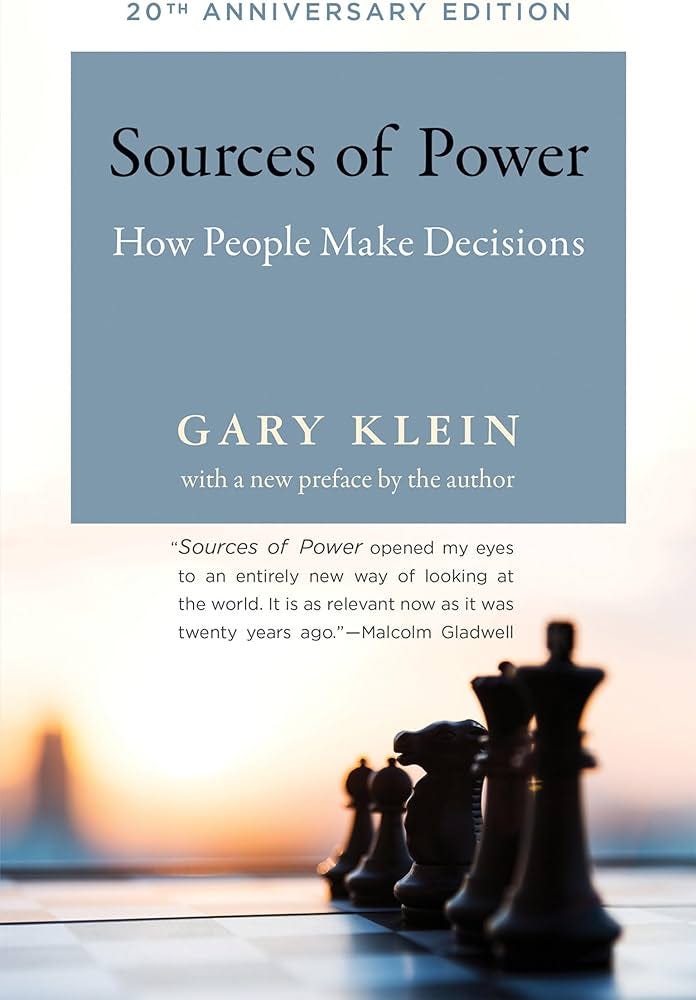
Stories like that of this firefighter do happen. We have gut instincts all the time about people, decisions, and situations. And sometimes those instincts are justified. But other times that instinct can lead us astray. The lesson from expertise research isn’t that gut instinct is rational and trustworthy - the lesson is that there is no substitute for deep familiarity which allows us to detect patterns even when we are not always aware of it. Gut instinct, like all tacit knowledge, is shaped by experience and needs to be trained.
Should I trust my gut instinct?
Gut instinct is not magic. It is just a sign that you are picking up on something that is hard to articulate. That hard to articulate thing might be valid, or it might not be. Whether you decide to trust your gut instinct depends on how much experience you have, the reliability of the cues you are using, and the consequences of acting or not acting.
For example, you might have enough experience with a close friend that you can recognize the signs and patterns that they have had a bad day, and have an instinct that they are upset. Yet, you still might occasionally misread the situation, as emotional cues are not one-to-one like psychology textbooks sometimes make it seem. So rather than jumping to conclusions, you might act cautiously and probe to see if your intuition is right, as assuming you know how they feel could blowback in your face.
In an ideal world, you would pay always close attention to your gut instinct, and over time get a sense for how accurate it is and would become better at discerning what underlies the instinct. In that way, logic and intuition would be working together to improve each other. But if you are googling this question, then you probably haven’t spent years building up your gut instinct in this way.
Overall, a gut instinct says there is something you are picking up on that you are not consciously aware of. I would pay attention to that gut instinct as a valid source of information, but also I would try to figure out what underlies that instinct as it may not be something you would care about if you reflected on it.
How do you study expertise?
In the domains I study, it is rarely possible to go out into the field and observe what experts do, but most who research expertise are skeptical that a lab environment offers enough fidelity to really understand expertise. The real world is complex in ways that are hard to capture in a controlled laboratory setting. Since expertise is fundamentally about adapting to context, the sterility of a lab setting defeats much of the purpose.
Because of this, the major approach for studying expertise is an interview technique called Cognitive Task Analysis, and more specifically the Critical Decision Method in which we ask experts to walk us through an event, minute by minute, detailing what they noticed and when. Sometimes we pair this interview technique with a recording of a real event to improve memory, and other times we will have the expert go through a scenario that we created.
It is important to note that we never ask experts, “Why did you do that?” and instead we ask what they noticed. This is because experts themselves are not trustworthy witnesses to their own cognition. They often confabulate an explanation that doesn’t reflect their true reasoning process (e.g., I have ESP). Instead we ask them to focus on what they noticed as that helps to reveal the cues they are acting on (e.g., the anomalies the firefighter picked up on which led him to order his team out of the house before it collapsed). Additionally, we like to ask them what a novice would get wrong, as that helps to identify the moments that are most difficult and require the most tacit knowledge.
For more on how to study expertise, I recommend the book Working Minds: A Practitioner’s Guide to Cognitive Task Analysis.
How do you train expertise?
Since expertise is so dependent on pattern matching, there is no real substitute for experience. You must learn what to pay attention to, and how reliable those cues are. If it is a situation where the cues are not reliable (such as predicting the value of an individual stock), or you can’t discern the reliability of cues (e.g., you are a complete novice who doesn’t know what to pay attention to), expertise is impossible to develop. Kahneman and Klein’s adversarial collaboration is worth checking out on this point.
Ultimately, expertise depends on good feedback that helps you to make sense of what patterns to pay attention to, and why they matter. The way we typically approach this in my work is by interviewing experts to understand real situations they have been in, and how they handled them. We then create scenarios based on these real experiences and create what are called ShadowBox exercises which have expert feedback embedded in the scenario. There are other approaches we use too, such as training visual pattern recognition through videos, and other experiences to help simulate real life decision-making.
The important thing to note is that we are providing cases and patterns that will help them to make sense of novel situations, and that they are receiving feedback and not merely passively observing. Many people spend years in a field and never become a true expert. Experience does not automatically translate into expertise. It takes effort and transformation of your underlying mental models.
Another thing to note is that we rarely train any explicit protocol or decision method. This is because expertise is the natural development of human capacity, and so its not any process that needs to be developed, but rather the experience base.
What about Deliberate Practice?
It depends on what kind of expertise you care about.
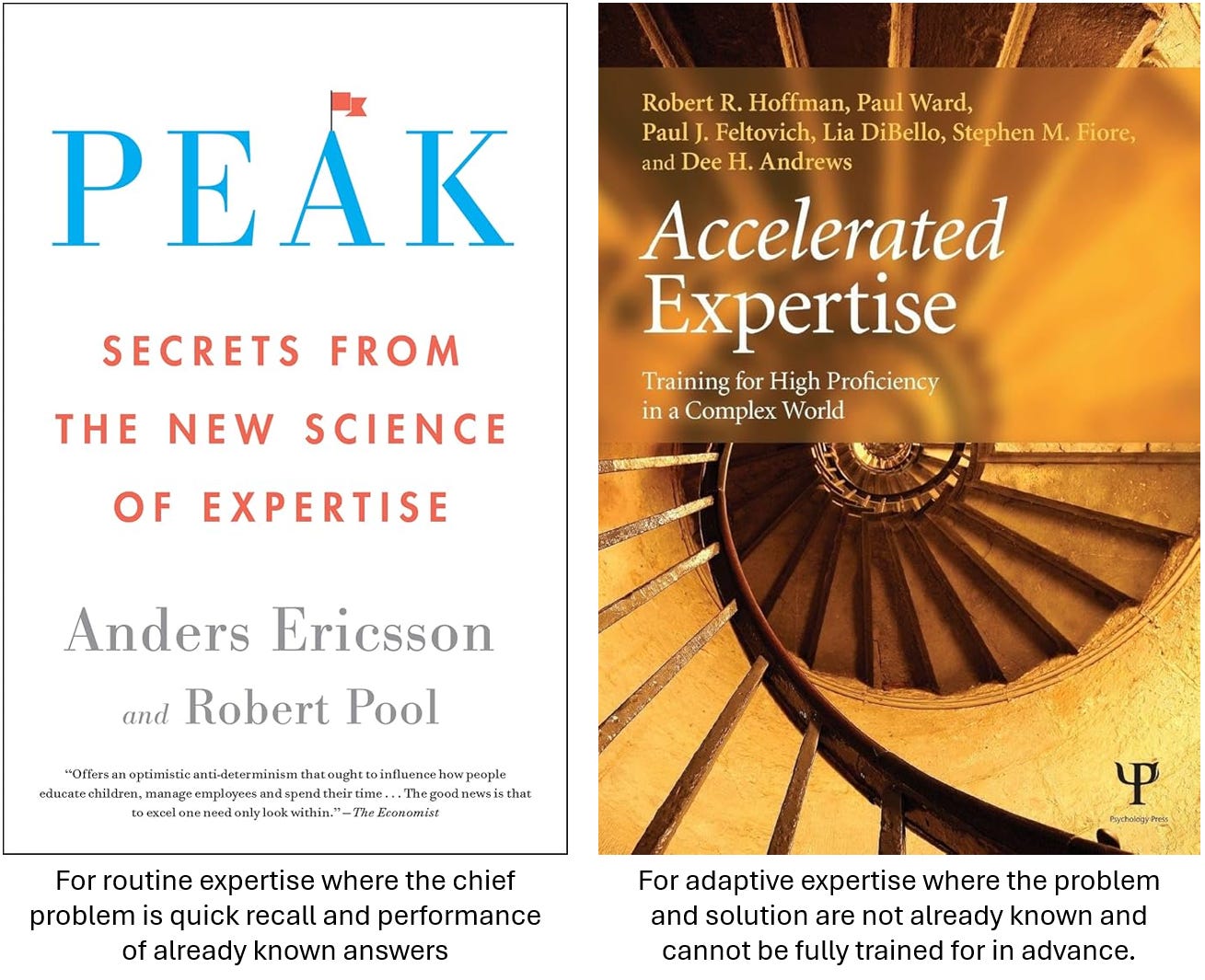
Deliberate practice is an idea developed by Anders Ericsson and was popularized in his book Peak: Secrets from the New Science of Expertise. The idea behind Deliberate Practice is that practice requires more than repetition, but targeted training of skills chosen by a coach to push you to the edge of your abilities.
Deliberate Practice can be useful, but I will give two caveats.
The first is that Ericsson believed that Deliberate Practice required a history of pedagogical development in which a skill hierarchy has been worked out, and a collection of training methods suitable for each skill is known. If this work hasn’t been done, deliberate practice is simply not possible according to Ericsson. Needless to say, not every domain has such a long history. But also, this can’t be universally true or no one could ever develop expertise in the first place. There must be ways of learning and training expertise besides Deliberate Practice.
The second caveat is that Deliberate Practice is good for highly structured skills like learning to play an instrument where the solutions to problems are already known, and variation is relatively minor. But it is less ideal for ill-structured skills like diagnosis in medicine wherein the same condition can manifest in hundreds of unusual ways. The need for studying expertise in ill-structured domains is where Cognitive Flexibility Theory comes from, and the researchers behind it have argued that Deliberate Practice worsens performance in domains where adaptivity is necessary.
If you are wondering whether Deliberate Practice is right for your domain, ask yourself whether the skill you are teaching is hard because the answers are known but difficult to recall and act on quickly, such as learning to play an instrument, speed running (but not running speed), or multiplication tables. If that is the case, then Deliberate Practice is great.
However, if the skill you are training is hard because you encounter novel problems that cannot be fully trained for, and so performance is not just recall but about creating novel solutions to novel problems, then Deliberate Practice may not be the best approach. For skills like that, then you may need adaptive expertise which is better trained through a case-based approach with good feedback as advocated by Accelerated Expertise.
As for sports and bodily movement…see the next question.
What about the Constraints Led Approach?
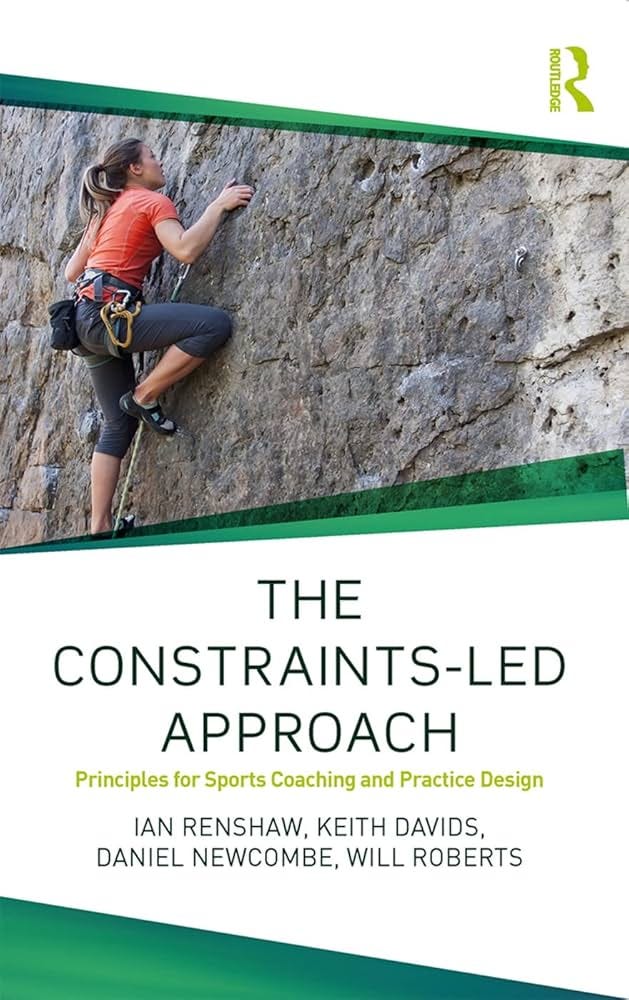
The Constraints Led Approach (CLA) is a training technique that focuses a lot more on the body, and how it adjusts to constraints in the environment. The premise behind it is that expertise is less about cognition, and more about the body in an environment, and how the two play off of each other in a dynamical system.
For example, one view of swimming is that there is an ideal way to swim, and the way to get better is to get closer and closer to that platonic ideal through error reduction. If this were the case, then Deliberate Practice would be ideal.
However, our bodies are all different and so no two people swim in the exact same way. Additionally, you swim differently now than you used to because of changes to your body. So if you want to learn to swim, you can’t be a robot that repeats the same motions endlessly, but have to learn to adapt to constraints and changes that naturally occur in your body and environment (or enforced by coaches). Adaptivity to these constraints leads to a generalized competence as opposed to a specifically honed skill that breaks down as soon as the situation changes.
Does this work?
I am a fan of CLA as a general approach, and will recommend the methods they use. But I will stop short of endorsing the theory. I like embodied psychology, but am a little more skeptical of ecological psychology which goes too far for me. I just don’t know how to explain expertise sufficiently within the ecological framework, and think cognition plays a central role in just about everything.
Why study expertise instead of rationality?
Rationality (as it is typically defined in the literature) is about using models that generalize across problems. By models, I mean things like Expected Utility, Signal Detection Theory, Bayes Theorem, and other “rational” models. These models are considered to be optimal across many different contexts.
Expertise is the opposite of these rational models. Experts do not look for models or rules that generalize across many different situations. Sometimes they will invent such a rule, but if you press on them you will realize how faulty and incomplete it is in practice, and how often they adapt the rule to the circumstances.
Instead, expertise is more about the ability to get increased specificity. By analogy, expertise is less like using generalizable models, and more like developing a novel context specific model in the moment. Rather than going from the particular to the general, experts use experience to go from the particular to the even more particular. In essence, what makes one person more expert than another is their ability to discern how situations differ in subtle ways that force them to adapt their mental models to each new situation. This is why Adaptive Skill [is] the Conditio Sine Qua Non of Expertise.
Returning to the example of making a left-hand turn at a busy intersection, a driver does not rely on Expected Utility to decide about when to go. Instead, they have so much context about their situation (the speed of the incoming cars, how fast their car turns, etc.) that they are able to discern the specific moment that is right for that particular context using qualitative reasoning.2
The problem with rational models is that in real life, situations are dynamic and the goals constantly shifting. Relying on an optimal model in such a situation is a recipe for disaster. Typically what we find is that only the novices in a domain rely on rational models, whereas experts are far too adaptive for their reason to be adequately captured by such models.
Because of all this I don’t worry too much about cognitive biases or rational models, and actually think rationality isn’t worth studying. If you care about studying how people should make decisions, then you should study expertise. I believe expertise to be an actual cognitive phenomena (the same cognitive phenomena as common sense) and the natural developmental process of decision-making. It's immensely trainable because of this, as well as incredibly engaging in ways that will make you question whether Behavioral Economics characterization of humans as “cognitive misers” is accurate.
Is expertise about generalizing rules? How are experts so adaptive?
Experts are not just generalizing rules, and it is important to understand this because it is what distinguishes humans from AI, and helps to explain why Naturalistic Decision Making is the best approach for studying expertise.
AI learns from generalizing from examples that it assumes will serve as templates for how to handle future situations. This means with AI systems it is incredibly important to train them on a diverse sample of cases that are representative of real life, or the model will overfit from the cases.
Training expertise is not like this. With experts, you can train them on atypical and difficult cases, and they will not generalize that training to the easy cases. You can even train experts from failures, and they will infer the correct thing to do. The reason for this difference is that expertise is fundamentally about pattern matching so that you can discern between situations, not about developing generalizable rules that apply across similar situations. Because of this, experts collect cases, and not principles, rules, or heuristics.
This is important, so let me say it differently; when it comes to training expertise, the cases are the primary thing being relied upon, and not merely examples to explicate generalizable rules. A history of cases to rely on is what allows experts to be more adaptive than if they were merely generalizing, and allows them to create and try new things that no one else has ever done. This is the main finding behind Cognitive Flexibility Theory, which I am repeatedly linking to in this FAQ for a reason.
What are some resources for learning about expertise?
I highly recommend the book Accelerated Expertise which is a great resource for understanding how to train expertise, and which focuses on two important theories: Cognitive Transformation Theory and Cognitive Flexibility Theory. Here is a book summary if you do not want to read the entire book.
That book summary is by Cedric Chin whose website CommonCog is an exceptionally good resource for those interested in becoming expert in business and entrepreneurship.
Working Minds, mentioned above, is great for learning Cognitive Task Analysis.
Sources of Power, also mentioned above, is a very fun read that will help you understand expert decision-making. This is currently the go to book for reading about Naturalistic Decision Making.
The Naturalistic Decision Making Association has a resources page I would recommend, including a podcast.
I would also recommend watching experts explain their process. Watch Simon of Cracking the Cryptic solve a very difficult Sudoku puzzle, and appreciate how much his logic depends on recognizing patterns which imply which logical constraints to apply. Watch GeoGuessr players explain their reasoning, and what they are noticing and looking for. Read up on how experts train across various domains.
Though of course, there is no substitute for experience. Go out there and become an expert yourself in something - you will learn more that way than through reading. There is no substitute for experience. (Then report back to me, as I would love to hear about it.)
I am also a resource! I love answering questions, and can point you to relevant papers. So please fire away! What else do you want to know about expertise?

Acknowledgements: Before pressing publish, I made some last minute changes thanks to some discussion at the recent NDM conference on the topics of CLA and Deliberate Practice. If I spoke to you at the conference about either of those things, thank you for your input!
I don’t think it will ever be settled
Which could be modeled quantitatively in a post-hoc way. But just because something can be modeled quantitatively after the fact does not mean there is any math happening underneath the hood.
Hi Jared,
Thank you for writing this.
I’ve only recently started the literature review for my PhD and, if I’m honest, I’ve been going in circles trying to connect expertise, competence, resilience and cognition into a coherent theoretical framework.
Your article reminded me of several concepts that I’d allowed to drift into the background—particularly tacit knowledge, pattern recognition, Cognitive Task Analysis and Naturalistic Decision Making. It helped me reconnect a number of threads, so thank you.
My research is in commercial aviation and focuses on cognitive resilience in highly automated flight operations. Increasingly, I find myself questioning whether the industry’s emphasis on competency and observable behaviours adequately captures what experienced crews actually rely upon when automation degrades or situations become novel and ambiguous.
One question I keep coming back to is this:
Do you see expertise as an extension of competence, or as a fundamentally different construct?
In aviation we tend to assess competence through observable behaviours and procedural performance, whereas your article seems to suggest expertise is primarily an underlying cognitive capability—expressed through pattern recognition, contextual discrimination and adaptation—that only becomes visible when routine procedures are insufficient.
My research ultimately aims to understand why two equally competent airline pilots can respond very differently when confronted with the same unexpected automation failure. My current hypothesis is that the differentiator may lie less in competence itself and more in adaptive expertise and cognitive resilience. Does that seem consistent with how you think about expertise, or would you frame that distinction differently?
If you have come across research that explores this distinction, or papers that attempt to operationalise expertise (rather than simply define competence), I would be very grateful for any recommendations.
Likewise, if there are any authors beyond the obvious Gary Klein, Hoffman, Ericsson and the NDM literature that you think are essential reading, I’d really appreciate your suggestions.
Many thanks again. Your article was genuinely thought-provoking and has helped clarify several strands of my literature review.
Best wishes,
Naveed
Another excellent post. Really great work. I have continued to dig into and use Stanovich since you wrote about this research a couple months ago. I am sure I will likely be using this essay, too, for quite a while.