
There is no System 2
An NDM account of Dual Process Theories

Introduction
System 1 and System 2 are, by traditional accounts, two modes of thinking which are comparable to Aesop’s The Tortoise and Hare. In the fable, the eponymous critters decide to race, but the hare is so confident that it decides to take a nap halfway through. When it awakes, it finds the tortoise has already finished.
The metaphor is well suited for Kahneman’s central psychological story; a System 1 style of thinking that quickly and overconfidently leaps to conclusions, and a System 2 that is slow and careful, and so eventually gets the right answer.
But my favorite similarity is the part often left unstated; they’re both fables. As Kahneman says of the dual processes in his book Thinking Fast and Slow;
“System 1 and System 2 are so central to the story I tell in this book that I must make it absolutely clear that they are fictitious characters. Systems 1 and 2 are not systems in the standard sense of entities with interacting aspects or parts. And there is no part of the brain that either of the systems would call home.”
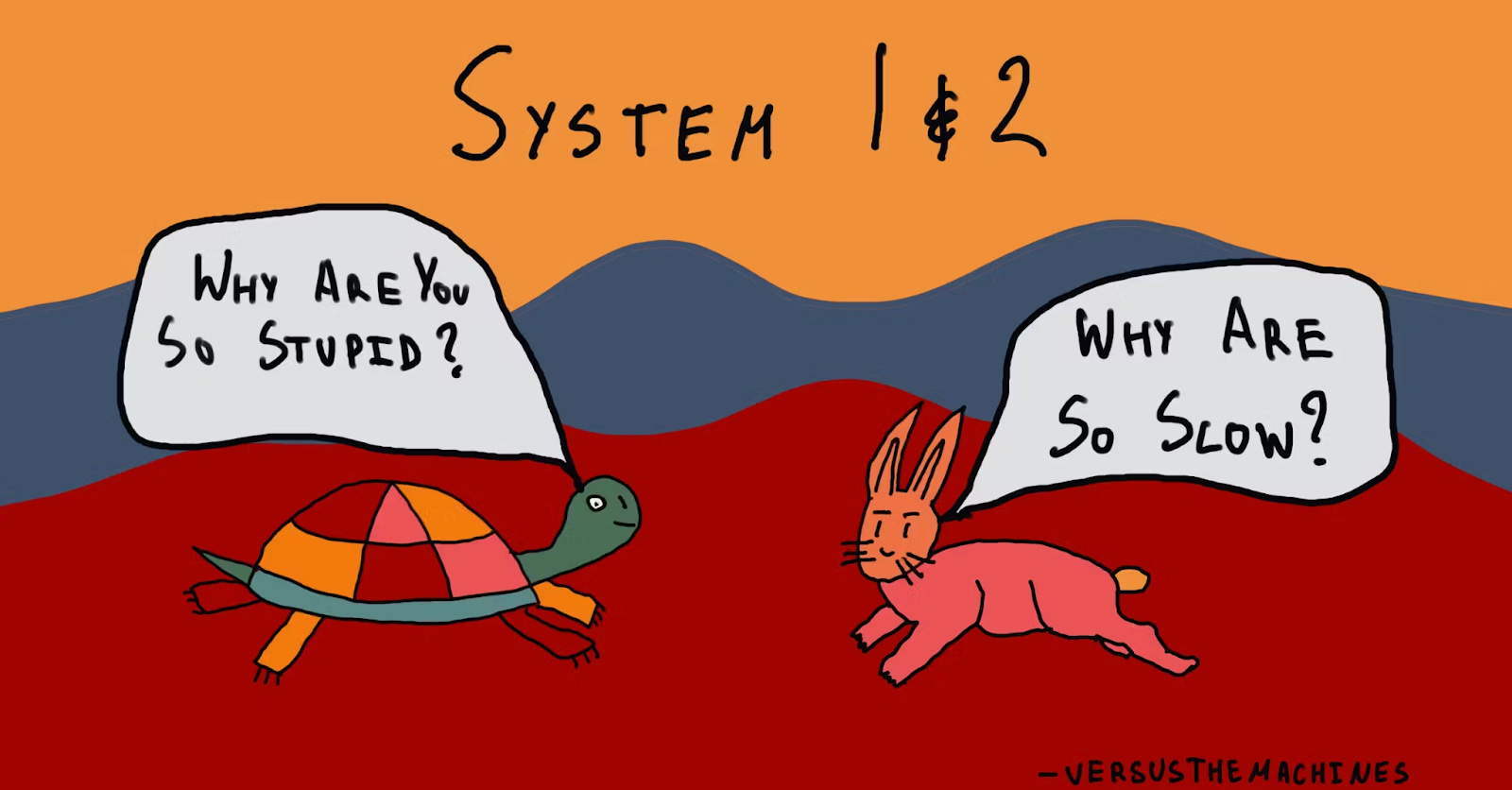
But dismissing Kahneman’s Fable as a mere fiction would be a disservice. The famous saying goes that “all models are wrong, but some are useful,” and I think that is true of these fictitious characters, as well. The distinction seems so obviously true to our experience that System 1 and System 2 are not even the only names we have given to it; logic vs. emotion, left vs. right brain, reptilian brain vs the neocortex, and (the most fun to bring up at dinner parties) male vs. female brain.
There have been attempts to move beyond this “Systems” terminology. Keith Stanovich, who originally coined the terms, no longer uses the word and instead talks about the Reflective Mind, Algorithmic Mind, and the Autonomous Mind. There have also been attempts to talk about Type 1 and Type 2 thinking. But none of it has stuck.
There is something interesting here we are grasping for, but so far it seems that we haven’t found terminology that isn’t just pure metaphor. So the field continues to use the fictional “Systems” language simply because it has not yet coalesced around a less false way of talking about it. And until we do, it perhaps makes sense to continue to do so.
But I think I now have a better story, which goes beyond mere metaphor, to actually explaining the illusionary distinction in terms of the actual cognitive processes we rely on.
The central idea is that System 2 does not exist; it is System 1 all the way down.

The shaping of system 2
The basic principle on which the brain operates is pattern matching. Karl Friston and many others say “prediction” instead, but they amount to the same thing. Neurons do not distinguish between these human concepts, and so I will not either; recognition, prediction, construction are just words we use to emphasize different aspects of the same electrochemical process that occurs in the brain.1
This process is described beautifully in How Emotions Are Made (a book I have talked about elsewhere). The patterns we observe, and the context in which we observe them, trigger electrochemical cascades through a network of neurons. These cascades start with the pattern input, and end with some predictive output. This process is System 1. Hardly a system at all except in so far as the entire brain is a system.
For example, when you see 2+2, an electrochemical cascade ripples through your brain leaving you with the answer of 4. Completing this pattern is trivial and easy for most people, and is the prototypical example of System 1.
Now consider the prototypical example of System 2; multi-digit multiplication problems such as 17x24. For many of us, the cascade is barely a trickle. We pattern match to recognize “I don’t know that” and then give up.

But if you actually had to solve it (without a calculator!), how would you do it?
There are a few ways to do it. If you do it by hand, you would write 24 over 17, multiply each digit together, and then add up the sum. Or if you want to do it mentally, I did it by multiplying 24 by 20 to get 480. But 20 is 3 more than 17, so I multiplied 24 by 3 to get 72 which I subtracted from 480 to get 408.
Whichever process you use, I can guarantee there is no need to evoke “System 2” to explain what you did. There weren’t two types of thinking involved. All you have to do is break down the problem into a series of easier patterns.
So what is System 2? It’s just pattern matching in a series. We can distinguish between Direct Pattern Matching to an answer versus a Structured Pattern Matching in an organized series of steps. But they’re both just pattern matching. Why evoke System 2 at all?
Pattern shaping
Of course, identifying that structure is an important part of the process. But that too is just pattern matching. We can call this Pattern Shaping just to give it a name, but we need to be clear that this name distinguishes a function—identifying a structure to bound subsequent pattern matching—but it is not itself a different type of cognition than the pattern matching which we have been talking about.
I recently came across a great example of Pattern Shaping by David Bessis who describes his first encounter with the bat and ball problem: “A bat and ball cost $1.10. The bat costs $1.00 more than the ball. How much does the ball cost?”
Most people try to pattern match and get this wrong. But David Bessis has done enough math problems in his life that when he sees a problem like this, he pattern matches to recognize it as the type of problem you can represent in terms of length. This is a really clever way of thinking of the problem, and very different from how I think.

If you want to see his approach, read his essay (or his book, which is on my reading list this year). The important point is that when viewed in terms of length, the answer was immediately and intuitively obvious to Bessis who has enough familiarity with seeing problems in terms of lengths.
Of course, what is easy for one person will not always be easy for another. Bessis may be able to solve problems by thinking of it in terms of lengths, but I cannot. Not because I am incapable, but because it is a novel way of thinking which I haven’t trained on. Pattern recognition is dependent on experience with those patterns. The cascade in our brain cannot pattern match to things it hasn’t seen enough to recognize. But if through pattern matching you shape a problem into a series of patterns you have seen before, then you can solve novel problems.
The idea that you solve problems by recognizing them in terms of problems you have seen before is something I talk about often, and for a long time.2 One of my favorite quotes from Herbert Simon applies this principle from mathematics to design thinking and the rest of problem solving
“All mathematical derivations can be viewed simply as change in representation, making evident what was previously true but obscure. This view can be extended to all problem solving—solving a problem simply means representing it so as to make the solution transparent.”
What kind of problem solving? Well, all the problems.
In the Recognition Primed Decision-Making (RPD), a model developed to explain the decisions of firefighters and warfighters, individuals “use their experience to directly identify the situation as typical of a standard prototype and to identify a course of action as typical for that prototype.”
In their description of expertise in real world contexts, Dreyfus and Dreyfus (2005) say that “normally an expert does not calculate, or solve problems, or even think. He or she just does what normally works and, of course, it normally works.”
Over in the world of Behavioral Economics, Bordalo et al. 2024 “offer a theory of decisions in which selective attention to the features of the current problem is determined by its categorization in a set of problems the [decision-maker] solved in the past.”
Or as Barry Schwartz and Richard Schuldenfrei say in their new book (which I reviewed), “Well framed is half solved.”
Sorry for so many references, but this is an important concept and may be what defines rationality. When we find a frame that allows us to utilize our existing repertoire of patterns, perspicuity3 into the correct answer is the result.
In a paper Joseph Borders and I have submitted to the NDM conference this year, we call this the Situation Shaping Hypothesis. The idea being that a large part of decision-making and problem solving is about finding a way to represent4 a problem where the answer seems obvious, or common sense. This was one of the original insights from Naturalistic Decision Making: the ways in which individuals made sense of situations often exerts greater influence on actions than does deliberation over a set of predefined options.
Again, I will emphasize that neurons do not distinguish between recognition, prediction, and constructing, and we just as well could have called it the Situation Recognition Hypothesis if we wanted to emphasize the pattern matching aspect. Regardless of the name, the point is identifying a way of thinking about the problem which breaks down the problem into something easier.
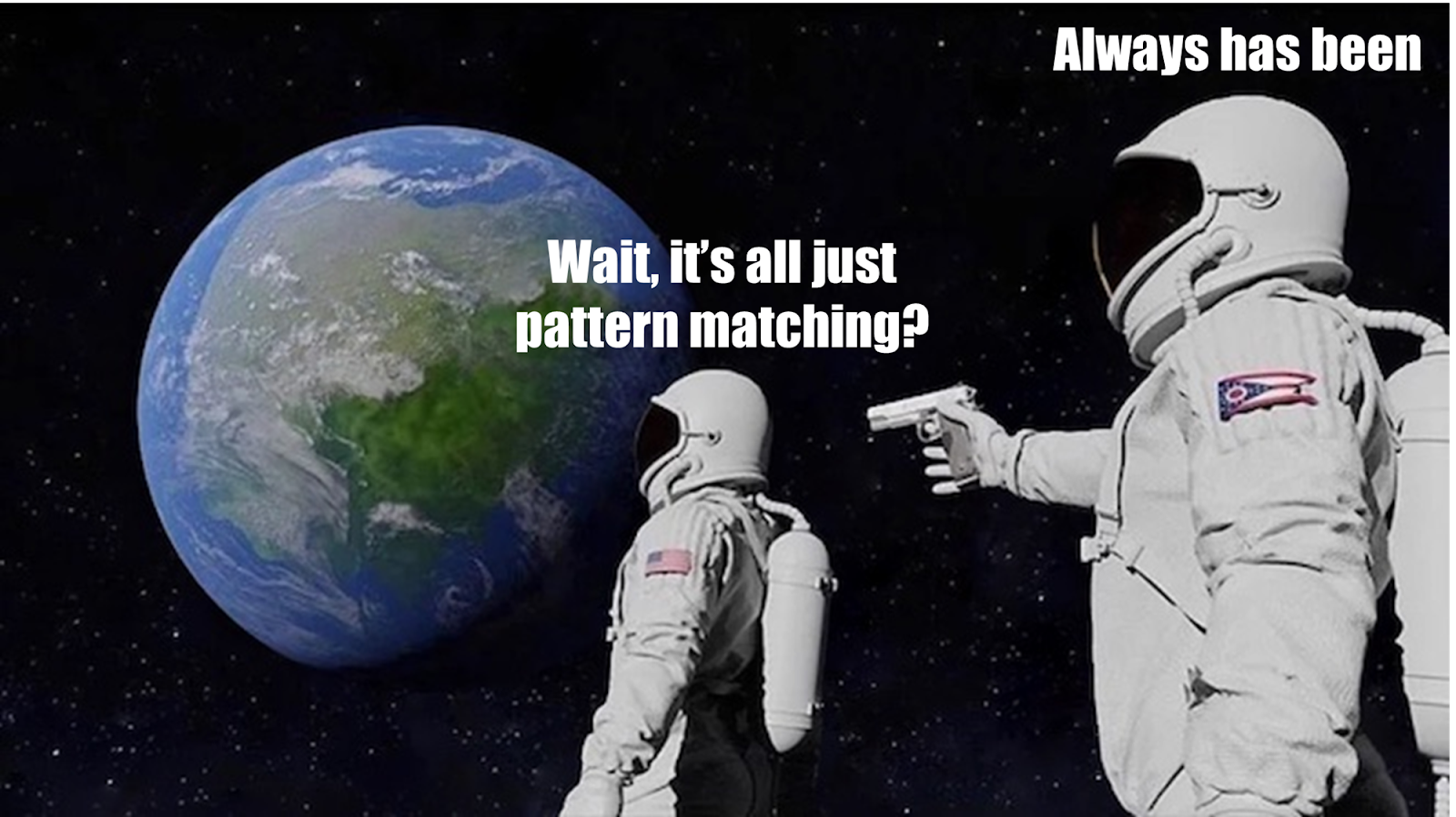
To summarize; the most basic function of the brain is pattern matching, and there is no process above and beyond that. However, while we can do Direct Pattern Matching to an answer, we can also pattern match to recognize there is a structured series of steps we could take, which I am calling Pattern Shaping. That identified meta-pattern binds and serializes subsequent pattern matches so that we can do Structured Pattern Matching. But at the end of the day, all three of these processes are just pattern matching.
Conditions for expert matching
In the Kahneman view, System 1 is seriously flawed, while System 2 is careful and logical. This account undermines that view significantly,
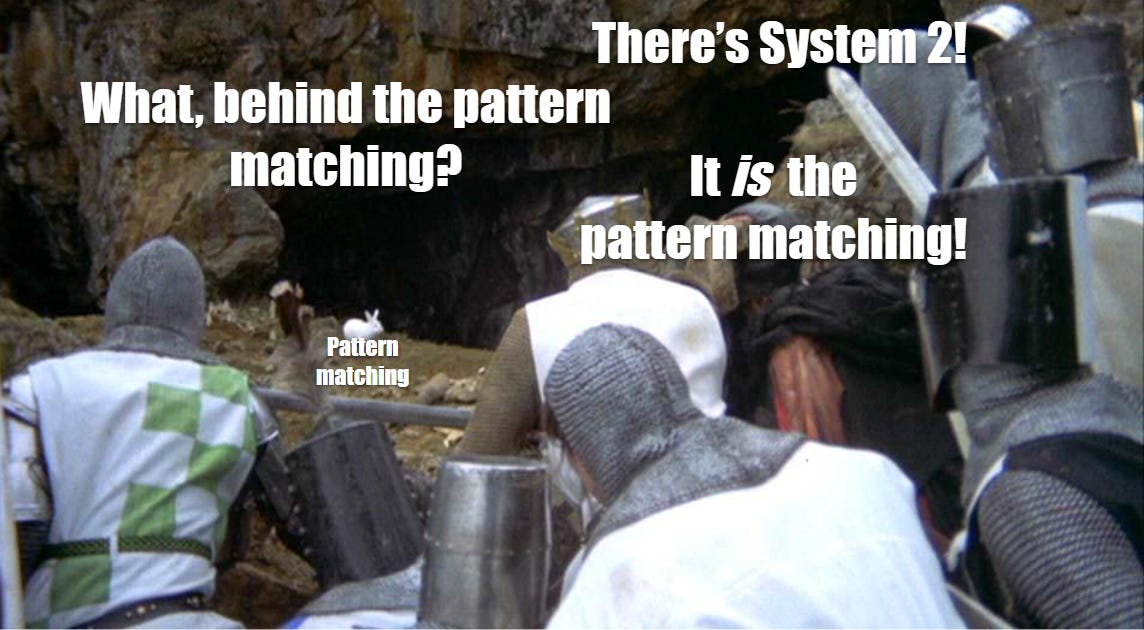
System 2 isn’t logical like a computer, but is instead a tower of fast system 1 pattern matches; one intuitive leap to recognize the problem in terms of a series of smaller leaps.

I think those who engage in serious logical problems will recognize this as closer to reality. For example, when I watch Simon of Cracking the Cryptic solve a Sudoku puzzle, I can follow and explain each step in his logic. But when I try to solve the same puzzle, I struggle to identify where the logic applies because I lack enough experience to do the same pattern matching. As it turns out, even when doing logic, pattern matching dominates as we depend on patterns to determine how and when to apply the logic.
This may sound familiar to those who have had the opportunity to speak with experts on how they feel about procedures and protocol. Nice, clear and logical procedures are nice and all, but the principal cognitive problem they are trying to solve is recognition of the nature of the problem. Because once the problem is recognized, the procedures may not even be necessary as the next steps reveal themselves. The procedures, at that point, are only aids for novices after someone more expert than them tells them what the situation is, as procedures can’t help if you don’t recognize the problem.
However, while this view undermines the careful procedural logic of a System 2, it does help to explain why “slow” thinking is often seen as superior to “fast” thinking. Structured Pattern Matching is indeed a corrective for more basic Direct Pattern Matching to an answer. We use such structured thinking precisely when Directly Pattern Matching to an answer is insufficient. In situations where you have insufficient experience for Direct Pattern Matching, you should add structure. And indeed, in our work we find experts tend to do both types of pattern matching; Direct and Structured. Perhaps the greatest misconception of expertise is that it is all intuition and gut instinct when in fact methodical thinking depends on expert pattern matching, and so experts provide some of the best examples of careful and methodical thinking.
But on the other hand, given how the brain works, enough time using the same structure can lead us to skip the Pattern Shaping and Structured Pattern Matching altogether. Even something as simple as 2+2 requires Structured Pattern Matching for one learning math, and even something as complicated as identifying how to put out a house fire can become Direct Pattern Matching when one gains enough experience. This is why many experts, such as firefighters, claim to never make decisions, as they have done the same thing so many times that they can Direct Pattern Match to the correct option.
Conclusion
I named my Substack after Kahneman and Klein’s famous adversarial collaboration, “Conditions for intuitive expertise: a failure to disagree.” At the end of that collaboration, they admit a failure to bridge their disciplines, but in their concluding sentence they invite others to try.
Consider this my contribution to the discussion. When we stop trying to force System 2 to be something distinct from System 1, both the strengths of intuition identified by Klein, and the weaknesses identified by Kahneman, become a little more intelligible.
When you find an effective way to represent a problem, it grants perspicuity into it. This happens not through mystical intuition, but by the simple fact that experts know how to frame a problem in terms of patterns they have seen before, and novices do not. Perhaps if we appreciated this, we’d have a lot less innumeracy in the world as we’d recognize our cognitive limitations as representational rather than computational. Once the representation is there, things click into place.
In fact, Kahneman anthropomorphized System 1 and System 2 for precisely this reason; he wanted to find a representation that made his story obvious. And that duo of characters he used did their job so well that they became embedded in the very way researchers talk about the brain.
But at the end of the day, System 1 and System 2 are as fictitious as the tortoise and the hare. We use such fictions to describe something true about reality, and that can be helpful. But in calling them System 1 and System 2, I think Kahneman gave these fictional characters the veneer of scientific explanation, which is a job they were never capable of accomplishing. And just as worryingly, researchers keep trying to add to the cast of characters, such as System 056 or System 378. It seems we are asking too much of this fiction, and I think we are in desperate and urgent need to move beyond it before it gets reified even more.
Hopefully this account offers something new: an account that bridges research traditions and replaces an overworked metaphor with a clearer explanation of what’s really going on when thinking fast and slow.
Addendum: I had been recommended against publishing this article because it contains new ideas, and I might get scooped. Or even if not scooped, journals might be reluctant to publish these ideas in the future because they will not be original. This is a constant trade-off I have to make and I am growing tired of it. Help me to feel better about my decision to publish original ideas on this on Substack by subscribing.
The last chapter of How Emotions are Made has a good discussion on this.
The first psychology article I wrote online made this a central point: The Science of Context. And many readers probably found me through my ranking of Behavioral Science frameworks, a topic I am interested in precisely because of this principle.
I am borrowing this term from Wittgenstein’s concept of übersichtliche darstellung. If there are any Wittgenstein scholars in the audience who have insights on how my arguments here connect to his work, I’d be eager to hear your thoughts.
Anytime I say “representation,” I mean it in the broadest possible way. In ways that even a non-representationalist should be able to appreciate. If you have a better term, let me know.
https://ieor.berkeley.edu/wp-content/uploads/2019/03/system0.pdf
https://arxiv.org/abs/2506.14376
https://researchworld.com/articles/system-3-and-storyhearing
https://pmc.ncbi.nlm.nih.gov/articles/PMC11947722/
1. got you a subscription. Will have to read a few more before I decide to pay.
2. The bottomless tower of bunnies is truly horrifying.
3. I'm old enough that 'making change' is a mental skill, not a matter of 'tap on the touch screen and do what it says'. And 'quarters' were a thing. Thus 24 * 17 is roughly 17 quarters. which is 425 ... minus 17 is 408. I can do this mentally faster than I can say it. So in Kahneman's introduction where it was contrasted with a photo of what I read was an angry young woman shouting, I was very confused. The math problem was fast for me. The 'identify the emotion' one failed to solve. Shouting in anger is not something I have seen much of. Angry people clench their jaws and hold things in. I did a survey of the people in my house at the time. Nobody else knew what the emotion was either. Since most of the people there were ex-military, it is not too surprising that we all converged on 'Sergeant. Giving an order she wants heard on the far side of the parade grounds' as the thing this most looked like. But what she felt like? puzzlement. I wonder how many people didn't get past the introduction because of a failure like this.
4. If you put a space between your footnote superscripts when you want 2 notes to apply to the same text, it will make things easier for those of us trying to tap the footnote with our fingers on a mobile device.
Default Mode Network (DMN) and the Executive Control Network (ECN) - these two networks are anti-correlated: when one activates, the other suppresses.
If that’s “all pattern matching” with no qualitative distinction — we will need to explain why these two networks are functionally antagonistic at the neural level.
The fact that the brain physically suppresses one mode to engage the other is hard to wave away with “they’re both just electrochemical cascades.”
What’s your take on functional antagonism between DMN and ECN?