
Thinking out loud: Mathematica - Chapter 1
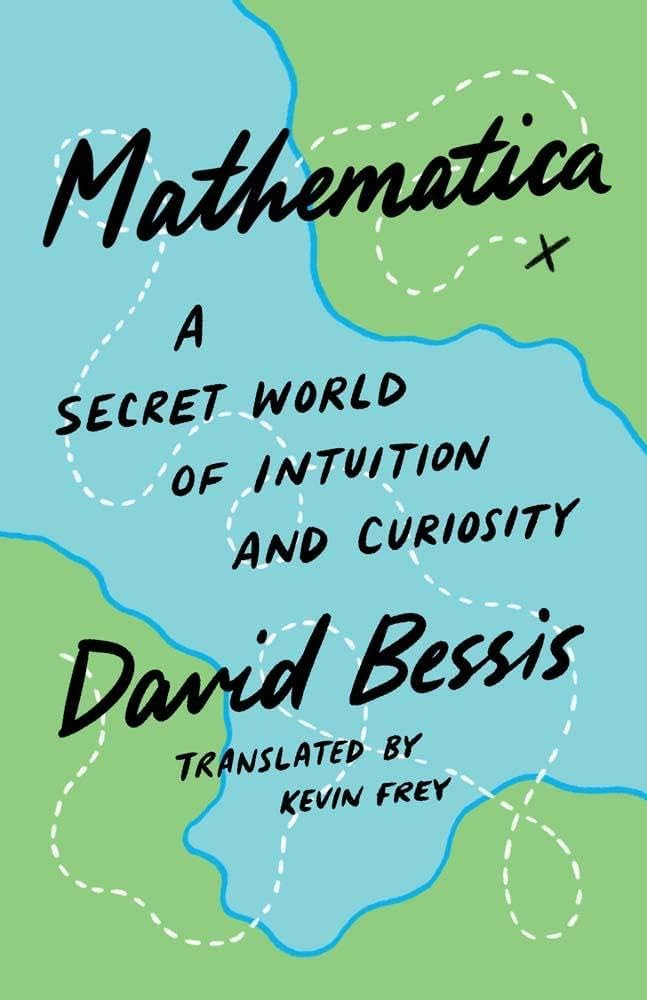
Half-baked thoughts as I read through Mathematica by David Bessis

I am starting to feel guilty for not offering benefits to paid subscribers. But I’m hesitant; if it isn’t a great article then it isn’t worth a paid subscription, and if it is a good article then I don’t want to hide it behind a paywall.
So here’s a short term compromise: I’ll share my notes on Mathematica by David Bessis with paid subscribers. I’ll still publish a full review for everyone, so no one misses the main ideas. But paid subscribers can follow the process and shape how I interpret the book. This article is public; the rest will be behind a paywall.
This “thinking out loud” series is me doing exactly that, and so it will be messy. Expect half-baked ideas, notes to myself, uncertainty in my interpretations, and aimless circling around of ideas as I try to find an angle I like. If you want to understand what I am talking about, it’s probably worth reading the book (which is worth it. Spoiler alert: this is a five star book).
Future perks for paid subscribers are still TBD. I’m considering Q&A posts based on comments and critiques I have received, and possibly more series like this. Suggestions welcome. If money’s tight but you think you will have a lot to say on this series, send me a DM and I’ll gift a free subscription. Good feedback that will help me shape my thoughts is more valuable than a single paid subscription.
Why I am interested in Mathematica: Tacit knowledge, deep expertise, and the joy of a good challenge
I wouldn't ordinarily be all that excited about a book on math. But this is an exception, as it overlaps with my work so much. I study a field called Naturalistic Decision Making which is a particular school of thought in decision science that studies expertise in fields like Law Enforcement, firefighting, medicine and other domains where stakes and time pressure are high, and experience is extremely important.
Those domains may sound quite a bit unlike math. Heck, sometimes I even define what I study by clarifying how academics are not experts in the sense I care about. To differentiate from academic knowledge, we also sometimes say we study deep expertise which is characterized by all the stuff that is hard or impossible to articulate; what we call tacit knowledge.
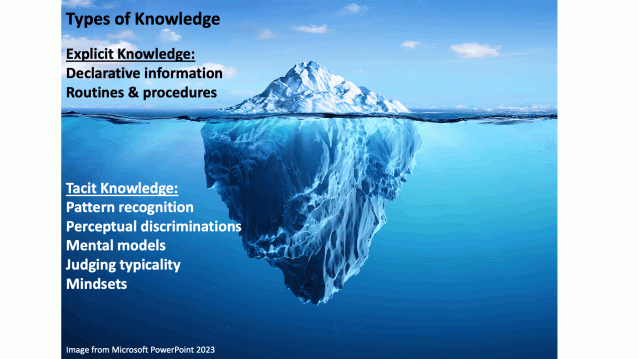
But the promise of Mathematica is that Bessis is going to teach us “secret math.” The stuff that isn’t articulated in textbooks. The thing all mathematicians know how to do, but which they have difficulty describing, and so isn’t taught in schools. Can you see my interest? This is a book on the deep expertise, that is the tacit knowledge, of math - the discipline that is typically held up as an exemplar of explicit calculation and logic.
Tacit knowledge is often defined negatively; knowledge that can’t be articulated. Daniel Kahneman disliked this definition and once got into a debate against Gary Klein (my boss) and Barb Tversky (then married to Kahneman) about the utility of the term tacit knowledge. No surprise, I side with the latter two. And actually, I love the negative definition even more than they do; tacit knowledge is the stuff LLMs are never trained on because it can’t be found on the internet. But more importantly, it is the stuff that allows us to engage deeply with problems, and so seems to me to be the thing that makes us feel the most human, the most alive, and to have the most meaning in life. Using tacit knowledge to solve problems gives meaning to what would otherwise be laborious calculation and drudgery.
However, I’ve never found that experience of meaning and satisfaction in math and Bessis has; what does he know about doing math that I don’t? It seems like mathematicians understand the tacit knowledge and the Agentic Mode of math in a way I have never experienced…
The Agentic Mode of math: “...a human activity of a particular nature”
Agentic Mode is one of my favorite concepts (see here, here). It is one of those that the longer I have dwelt on it, the more central it has become to my understanding of cognition and human well-being.
The term Agentic Mode was coined by philosopher Thi Nguyen to describe how certain problems (especially games) evoke certain ways of engaging with the world, and how it is in the evocation that a game becomes an art form. A game might have other things going for it (maybe beautiful art work, or a good soundtrack), but it is the mode of engagement, the human activity it pulls you into, that gives it beauty. And not just games! There an entire class of activities Nguyen calls Process Arts which evoke beauty through the human activity it invites. For example, painting, cooking, and dancing can be enjoyable independent of the art, food, or dance performance that results.
As I read this chapter, it strikes me that Bessis is trying to describe the Agentic Mode of math. Math itself is a Process Art which evokes a certain human activity that has its own beauty. Bessis has another article where he argues against platonism and nominalism, and instead argues for a constructivist view. But perhaps just as much he is claiming that math is it’s Agentic Mode.
The agentic mode of math simultaneously (1) defines what math is and gives it its joy, (2) is distinct from but related to the Agentic Mode of becoming better at math, and (3) gives mathematicians their edge. (See Bessis three secrets on page 8. Not entirely sure of my description of the second secret)
On point 1, Bessis says “there is a latent consensus among mathematicians about what it means to do math and what it feels like” (emphasis his), and that “If this consensus were to be turned into a definition, it wouldn’t characterize math in terms of what it studies, but as a human activity of a particular nature” (emphasis mine). For Bessis “doing math is a physical activity.”
(Do I see hints of his fellow alum (archicubes?) Simone Weil here? None Enters Here Unless He is a Geometer).
When I was a kid, I thought the Agentic Mode of math was something like “exactness” and “logic,” and that those who enjoyed math must enjoy it because you can be incredibly exact and get the exact correct answer. I wasn’t entirely wrong; that seems to be the Agentic Mode schools promote, and some do learn to enjoy that. But Bessis seems to be pointing at how the Agentic Mode of doing math in school, and the Agentic Mode of a mathematician, are entirely different. The mode of a mathematician is more like meaning-making; you find a way of thinking about the problem such that everything comes together, and you can just see right through the problem. Or perhaps it’s more like the moment in a game when you see the winning move, and take it. I can see the appeal of that.
“This story deserves to be told”
This all reminds me of Wittgenstein a bit. He was a mystic and a romantic stuck in the body of a logician. He wanted to write about art and music because he thought that real learning came through those mediums. But what he knew was logic, and he couldn’t ever quite get to the point where he could explain through logic what art and music could teach (I wonder what he would have thought of tacit knowledge, deep expertise, and embodied cognition?).
Bessis seems to have been struggling with something similar in that he wants to push people to see through the logic, and was frustrated that for so long he didn’t have the words to describe it. There is a similar existential angst both share in that the world at large is focused on the form of an argument, and both Wittgenstein and Bessis want the words to describe how people can see past the words and formalizations (which are mere constructions) into the deeper more embodied reality.
“...no, mathematicians don’t think logically. It is in fact utterly impossible to think logically. Logic doesn’t help at all with thinking.”
This resonates with me as someone who has occasionally enjoyed doing variant Sudoku. Regular Sudoku is rather boring to me. But if you start adding extra logical constraints, it suddenly gets very interesting very quickly. Such puzzles can be incredibly complex and require lots of logic. But in a way it’s not logic at all, but more like flashes of pre-logical insight where you just suddenly see the move you are supposed to make. I’ve written about this elsewhere, but I agree with Bessis that we don’t do logic. I think it is pattern matching all the way down, and Bessis seems to agree.
Einstein: “I have no special talents. I am only passionately curious.”
I also resonate a lot with this quote from Einstein. I wasn’t a particularly “smart” child. In elementary school I did Hooked on Phonics and Hooked on Math because I was struggling. I had mediocre grades, did a special program called Bridges with other struggling students (still don’t know what that was about - did they think I had ADHD?), and was in the 60th percentiles in my elementary-age Stanford test scores. I never did the SAT’s or ACTs in high school because no one told me I was supposed to sign up for them, and I missed the window. I didn’t exactly show a lot of promise.
But as the years went on, things improved. And by my my late 20’s when I was studying my masters at an Ivy League, my class ranked me as the number one person they would go to for help on their homework. Some people have even said I’m the smartest person they know - and some of those people weren’t even my mother! But this is of course a ridiculous claim. My IQ is at most “average college student.”
But what I do have is a desire to think deeply. Thinking is fun. I love wrestling with a particular thorny problem and trying to find a way to represent the problem such that everything clicks into place, and the answer becomes clear. This is my peculiar Agentic Mode with which I wish to engage with the world. It leads me to consume and debate academic content for hours. Extroverts get energy from talking with other people; I get energy from engaging deeply with ideas. Some people get discouraged when they can’t work through a problem; it makes me all the more curious.
This relentless interest in ideas can give the appearance of IQ-smarts, and maybe IQ is a part of the story - but you are delusional if you think it can explain more than 10% of the difference between me and the average reader of this Substack. If I seem intelligent, it comes down to passion, niche curiosities, and a whole lot of time debating people on the internet.1 It is definitely not raw processing power, better working memory, or whatever flavor-of-the-week IQ research comes in these days.
Which brings us back to Einstein’s quote. When you discover the peculiar Agentic Mode/human activity/invisible mental moves involved in a particular intellectual pursuit, you also learn the beauty of it and can’t get enough of it. You develop an endless curiosity and fascination with that mode of engaging with the world which allows you to pursue your intellectual curiosity past the point where others give up. And people will be amazed at all that you know, and impressed with your intelligence. But in a way, that intelligence is total bullshit. You’re not any smarter - you just have access to the Agentic Mode that allows you to pursue ideas like a World of Warcraft player on a 24-hour binge.
Bessis did math, I did psychology. Neither of us care all that much about IQ because we realize raw IQ cannot explain the variance we see. The epistemic and motivational problems of learning a discipline disappear when you learn how to use and find joy in the mental moves of that discipline.
Why nurture over nature
It’s interesting that Anders Ericssen (another student of expertise) was such a believer in nurture over nature. He thought genetics explained approximately 0% of anything, and was quite radical in this view. His view is too extreme for me, but perhaps it is not surprising that those who study expertise might come to question the conventional strong determinism of IQ. We regularly see people of average intelligence do amazing feats, but then still see obvious gaps that makes us realize that even these amazing individuals are nowhere close to the ceiling of their ability. Also, they are completely average in other aspects of life.
I think it’s silly to deny intelligence altogether; as Bessis acknowledges people clearly differ. But when you see someone do a feat as impressive as playing a violin at an expert level, how could you possibly think: “oh they must just be smart”? No, the gap that exists between mediocre and superb is principally a gap in skill and practice, and perhaps access to that peculiar Agentic Mode unique to that skill. IQ can explain some of the difference maybe, but it’s such a miniscule part of the story. Gaps as large as that cannot be explained by genetics. IQ is swallowed by expertise, experience, and relentless pursuit of ideas.
The oral tradition
The idea that mathematicians hide true math because it seems less serious should resonate with anyone who is familiar with how experts treat rules and procedures. Or anyone who, like me, thinks that Rational Choice Theory is a failed theory of decision-making that only sticks around because of the veneer of rationality. All too often these things are mere post-hoc rationalizations of what our intuition already knows is right, or bureaucratic requirement for the sake of having something that gives the illusion of objectivity.
That is all for now. I will share my thoughts on chapter 2 and 3 next Saturday. I suspect early chapters will be the most rich with new thoughts and ideas, and that later chapters will be more about consolidating ideas.
It’s hard to find people in real life who want to talk psychology and philosophy for 6 hours straight.
Your notes are hardly half-baked and aimless! The questions of "intuition" vs "tacit knowledge," and the upsides/ downsides of negatively framing what is unarticulated (like tacit knowledge), are interesting ones. Two of my friends from theoretical psych published a book on the philosophical roots of intuition and its treatment in different fields - I can send it to you if you want.
https://www.cambridge.org/core/books/rational-intuition/404C1BD29F601AB772195670C07158CB
As for wondering what Wittgenstein would have thought of tacit knowledge, expertise and embodied cognition: he talked about this quite a bit I think, at least indirectly. His notion of "forms of life" as the implicit background of social practices that we all instinctively understand (including language games) gets at a lot of this; perhaps the difference is he approaches it at a social level. But he certainly wrote about bodily intelligence and there has been scholarship on that. I think you're right though that he was like an artist trapped in a logician 's mind (or maybe it was the opposite?).
"This is my peculiar Agentic Mode with which I wish to engage with the world. It leads me to consume and debate academic content for hours." It seems like passion, interest, obsession and/or desire are core to what the Agentic mode is about: being able to tap into a powerful wellspring of meaning and thus, source of motivation. (Now I'm taking notes on your notes!).